Whenever I teach a Reiki class (and when I received my own Reiki attunements) I always go through some sort of deep challenge or shift in energy before the attunement. Once I broke up with a boyfriend – an amicable breakup that just needed to happen; several times I got sick; another time, just before attuning a Reiki Master, I started a new and serious relationship (ended up marrying the guy).
I’m going through just such a shift now, I realized. Not because I’m going to teach a Reiki class but I because I am about to have my second child. Several mamas have told me that the transition to child number 2 was a biggie. I realized that must be a large part of the stressors and health challenges I’ve faced (and my husband has dealt with) since the beginning of the year.
If you’ve been following my blog at all you know we’ve had a few snafus regarding our house, health, and car lately. Last week I encountered another upset. I’d been struggling with moderate back pain, and then bam! My sacral/lumbar vertebrae went totally out of whack. I couldn’t drive, walk, sit, stand up… it sucked. Lots of metaphors here: paralyzed by life, feeling the total lack of support, sick and twisted (ha, ha). I found a fantastic chiropractor who also does acupuncture and kinesiology, who was able to straighten me out and helped me get at the emotional issues underlying what feels like the biggest health challenge of my life so far. The issue? Trust! You may know my other challenges of this year have dealt with Faith – well, this one went even deeper, to trusting those in my life and even my self. I saw how I have difficulty trusting people, and how this year with my graduating (pending, anyway) with my MFA and publishing a second book and writing my first novel I’ve been struggling with my deepest issues of self trust, like doubt, disgust, and lack of faith in my talent and abilities. Funny how success can make one feel both proud and simultaneously totally freaked out and inept.
The issue of trust goes so deep and can be so transformative. Trust versus mistrust is one of the basic foundations of the self according to Erikson. I don’t know if I didn’t develop a strong enough sense of trust in the world as a preverbal infant and toddler, and frankly I don’t care, but I could see in the present how hard it was for me to trust my chiropractor, my husband, my friends, and my work. And underneath all that, my self.
Something a friend said came to mind as I struggled with trusting myself and others. She said, “A goddess doesn’t look to others to give her love.” Something shifted as I inserted “trust” here: A goddess doesn’t look to others to prove their trustworthiness, to prove the trustworthiness of the world. She knows it, because her sense of trust and faith comes from an inner connection to the divine. I can’t go back and change what I might have felt as an infant (if that was even the problem), but I can cultivate a sense of trust in my inner divine nature, and go from there.
This realization paired with the EFT (Emotional Freedom Technique) and kinesiology my chiropractor used helped me clear a whole lot of old crap standing in my way.
And then guess what happened? We had a clog in our main sewer drain and had a guy come and rooter it! Talk about crap (and, yup, roots) being in my way. All cleared out.
So: I’m clearing energy to move to the next big phase of my life as an author and as a mama and as a person. I wish you, too, dear reader, clarity and insight and health on your own path. I hope my journey helps to illuminate some of your own.
Wednesday, June 24, 2009


Saturday, June 13, 2009
Weeds and more weeds
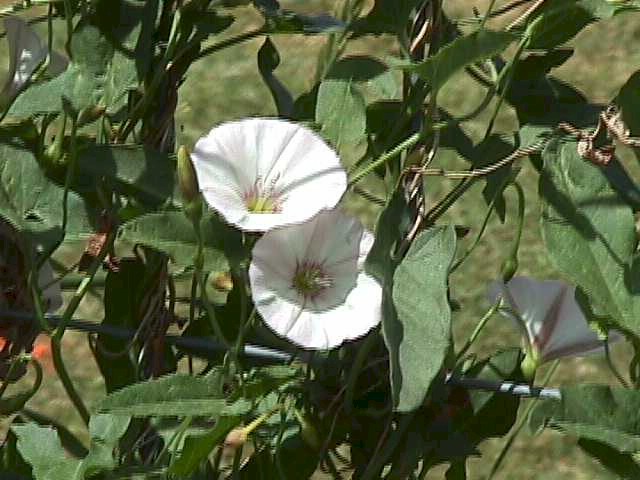
The garden has me contemplating weeds and their lessons. I know - sometimes a weed is just a weed - but as I pluck bindweed from my yard over and over only to see it return with a vengeance I can't help but feel that maybe there is some lesson or opportunity here. All is holon, all is connected. I admit I am having a hard time with this one, though.
I was not acquainted with bindweed, Convolvulus arvensis, until I moved to Colorado and noticed the pretty white flowers of the vine growing alongside my beans. Ah, but now I know. "Field bindweed is more than a nuisance; it's a pernicious weed. Like many nonnative invasives, bindweed is a tough plant that threatens to take over once it gets a toehold. Its cosmopolitan presence in many temperate climates has earned it 84 names in 29 different languages — most of those names are not kind." Writes Sue Dockstader. (1)
My daughter (age three) had the solid suggestion that we should fill up two buckets of weeds a day, no more and no less. Unfortunately I have others things to do in life than pull up bindweed. And sadly my chickens don't eat the stuff. It grows through our weed cloth. I am tempted to buy weed killer - but then I read that herbicides actually don't work all that well. They say the best approaches to the noxious plant is solid weed cloth combined with steady pulling and the possible addition of bindweed gall mites. Lovely.
The thing is, I am not anti-weed. I pull dandelions and mallow if it gets too tenacious or thick in an area, but these plants are edible and return nutrients to the soil. They are not out to cover my entire yard and house. Bindweed is. And I don't feel safe putting it in the compost, where it will spread even more. So it's not even food for compost.
So... I am left trying to take a positive spin on the stuff. What has it to teach me? That life is full of weeds like credit card debt and leaking seals and dead branches? That we have to take a sense of humor and get a good pair of garden gloves? That life's bounty comes in unexpected places? I'm not sure. I'm reluctant to accept the suffering and hair shirt approach to growth, though I have yet to see the point of bindweed through any other lens.
I suppose weeds in the garden, especially noxious ones like bindweed, have something to offer about tenacity, as my daughter innocently decided. Maybe I need a bumper sticker that says Weeds Happen. Hmm.
(1) http://www.pesticide.org/bindweed.html
Monday, June 8, 2009
Chicken Meditation
Another thing I didn't know about chickens: watching them poke about my yard is a calming meditation. Thought I'd share it with you here. The film quality is a bit choppy - kind of reminiscent of old film footage, but in color!
Enjoy...
As these four little free rangers, Maisy, Millie, Sylvie and Tallulah, wander about my yard, pecking, picking and clucking, time slows and life is good.
Enjoy...
As these four little free rangers, Maisy, Millie, Sylvie and Tallulah, wander about my yard, pecking, picking and clucking, time slows and life is good.
Saturday, June 6, 2009
The Law of Attraction Comes from the Heart

My husband and I were discussing our three-year-old daughter's stress level that she is clearly picking up from us. It got me thinking about how I broadcast my stress to my daughter, and how she is not only picking up verbal and nonverbal cues from me, but also swims in my electromagnetic field. The heart is the strongest producer of this field. "[T]he magnetic field produced by the heart is more than 5,000 times greater in strength than the field generated by the brain, and can be detected a number of feet away from the body, in all directions." (1) Via entrainment (2), anyone inside my heart field (as my daughter is most of the time), would pick up on my vibrations (I'm speaking literally here, not just esoterically) of frustration, fear, anger, and stress. She would vibrate with me. As would everything else in my field, to an extent.
This, I realized, is the key to the Law of Attraction. How I vibrate attracts like vibrations. If I am clenched and stressed, I draw constriction and fear. If I vibrate peace, abundance, and gratitude, I draw these energies to me. This includes wealth and success.
We can use our strongest field creator, the heart, much more effectively than just the brain (mind) to create a world we want to live in. Literally. The Law of Attraction requires the heart, not just affirmations said by the brain (though it is all connected, I realized how vastly powerful working with the heart directly can be).
This became my meditation, to feel these powerfully pleasant energies in my heart, creating a powerful field of attraction. What I discovered about myself was stunning.
I live a great life. I have an amazing, beautiful, healthy little girl. I'm pregnant with a strong, healthy little boy. My husband is a music therapist at a major children's hospital. I have published two books, one ebook, and dozens of articles in magazines I believe in. I have a truly amazing group of friends and family. We live in a more-or-less affordable house we've made into a sweet suburban homestead with an organic garden and chickens. In many many ways I am living the dream. But financially we are always strapped; the stress my husband and I have struggled with recently has been due to increased credit card debt to pay for a necessary and rather huge plumbing job, followed by a car accident that thankfully resulted in no human injury but meant replacing our old car. With another old car. We have money set aside for the birth of our baby, but that money has dwindled due to a tooth crown, new glasses, and other health necessities. Though we live fairly frugally, we are always scrambling financially. We have no savings (beyond meager retirement savings) and a big chunk of debt. We keep asking ourselves, what is it that we need to learn here? Why is money always uber-tight? In what ways, for instance, am I holding myself back as a financially successful writer? If money is an energy, an exchange of time, love, and human energy, then why are we chronically strapped?
Well, in tuning into the energy of my heart, I discovered some very interesting things that probably have something to do with our challenges. And are very interesting, too, in light of my family's medical history of heart disease and defects.
What I realized is that my heart is always clenched. Low-level anxiety always simmers, which I can feel as a tightness around my heart. I breathe into my belly, but almost direct my breath around my heart, rather than through or with my heart, as if avoiding the fear held chronically in my chest. When I pay attention to my heart, a panicky or sad feeling rises up my throat and into my eyes. I notice the clench of my jaw. I feel these things when sitting, doing chores, driving, and otherwise going about my day.
Then there is the added frustration I feel when doing something with my daughter. Like trying to get shoes on her feet or bake cookies. She is three. She does things in her time, and messes happen. While I am usually outwardly patient, on the inside, my heart waves are moving more and more towards frustration, impatience, and even rage.
I do not want my daughter to soak in this miasma of energy. Nor my unborn son, nor my husband, nor myself, nor anyone else.
So I breathe into my heart. I focus on the beauty of my daughter and my love for her. But sometimes, this is not enough to "turn off" the chronically clenched feeling. Baby steps, but not the huge shift I was going for.
Anyone who has dealt with anxiety (most of us to some degree), knows you cannot just dissolve the anxiety with deep breaths. Yes, it gets better, livable, but doesn't go away. To really heal the pain, to really find tools for a new relationship with anxiety, fear, and anger (3), we have to go into it. Not an easy task.
I won't tire you with all the details of my own "going into it." I highly recommend for your own journey tools like a journal, an art therapist, a shaman, or other support to help you do your own going into it. But I will share with you a deep insight I had in the process.
I was lying awake in bed one night, thinking. I was contemplating my family history of heart problems. As is easy to do when one is near sleep (and one is either morbid or prone to anxiety or both), I was imagining being in the hospital for heart surgery, which is how my paternal grandmother died when I was an infant. In my fantasy, I am telling the doctor I don't want to die - not because I am afraid of death, but because I didn't want to leave my children. I said I wasn't ready (am not ready) to leave this life yet because it's such a wonderful gift that I am not yet done enjoying.
My heart flooded with peace, abundance, gratitude, and joy. The anxiety stepped aside. The stress over money became moot. Life is bigger. Love is bigger. These are the energies I want to broadcast, to stew my children in. These are the energies that can attract to me the life I want, above and beyond the beautiful blessings I already enjoy. I found the tool I needed to change my relationship with my anxiety: focusing on the gift of life when wrapped in the loving arms of death. Forgive me for sounding morbid, but I can't think of any other way to say it.
What do you carry in your heart, dear reader? What tools do you need to create powerful fields of ultimate potential? I invite you to join me as a heart mediator. Let us see how our bodies and lives change as we go into the "darkness" (via negativa) and embrace the "light" (via positiva) (4). Truly anything is possible, and I'm excited to see where this path leads.
Namaste.
(1) Institute of HeartMath. "Science of The Heart: Exploring the Role of the Heart in Human Performance." 2009.
(2) See Entrainment at Institute of HeartMath.
(3) I don't mean eliminate it. Anxiety can be normal and valuable when directed well. See One Less Thing to Worry About: Uncommon Wisdom for Coping with Common Anxieties
 by Jerilyn Ross.
(4) The four fold path of Creation Spirituality: Via Positiva, Via Negativa, Via Creativa and Via Transformativa. See Matthew Fox's Creation Spirituality: Liberating Gifts for the Peoples of the Earth
 .
.
Thursday, June 4, 2009
10 Things I Didn't Know About Chickens

...Until I raised four of my own in our suburban backyard (and this is pre-egglaying, so there is more to learn). In no particular order...
1. They put themselves to bed at night. Come dusk, they hop up into the coop and tuck in. Our four pile up on each other in a corner of the coop, though I keep adjusting their roost to see if I can entice them on to it. We shall see.
2. They are totally fun to just watch. A running chicken is really one of the funniest things ever. And no, I don't have to chase them, they run all the time as they poke around our yard. They sit in funny poses, they take dust baths, they do a little chicken dance to scratch at the dirt. Totally entertaining. Anyone who has chickens knows what I mean, and anyone who doesn't will think I've gone off the deep end. Which maybe I have.
3. They cost almost nothing to keep. I bought a fifty pound bag of chicken feed for less than $25. That will eventually get turned into eggs (the freshest there is!), and is already turning into awesome compost. My cats cannot boast such economy.
4. Along the compost theme, the nitrogen/carbon ratio of chicken poo to wood shavings we get from the coop, which we clean less than once a week, is ideal and breaks down very quickly. And it doesn't stink. I can smell it, but it's not unpleasant. (Poor cats. Can you see a theme here?)
5. They are really soft. Chickens look all tough and nearly reptilian, but their feathers are very soft. So are their legs. Who knew?
6. They make sweet crooning noises when they come over to say hi. Which they do whenever I sit in one place. One of our chickens is more imprinted on us, and therefore more friendly, but they all come over and croon. It's probably a plea for treats, but it's a very sweet sound. I also love the way they look at me: part curiosity, part affection, part wariness. All chicken.
7. They are fascinated with my cats. And not afraid of them at all. In fact, my boy cat is afraid of them. He is twice their size (but they're catching up to him). They are actually fascinated with just about everything, though somewhat easily spooked. They are chickens, after all.
8. I thought all chickens loved earthworms. Not ours. But they can catch a small green spider in the blink of an eye, and apparently they eat mosquitoes, too.
9. They eat dandelion seeds. Since I don't use any weed killer, this is a nice bonus. I have four chickens and a thousand dandelions, so you can guess who is winning, but it's a start. They also love pansies. Sigh.
10. They are really quiet. Apparently when they lay an egg they like to announce it, but for now the loudest squawk is quieter than a crow or a jay. Can't say the same for my neighbors' barky dogs. And no, we do not have a rooster, which you do not need to get eggs, so we do not bother the neighbors.
Can you tell I'm hooked? If you're considering chickens, I have three words of advice: Go for it! You'll love them!
Wednesday, June 3, 2009
The Family as a Garden: Conscious Co-Creation of the Day-to-Day
I wanted to share with you Machaelle Small Wright's definition of a garden:
"According to nature, a garden has just three criteria: It is initiated by humans, given its definition, direction, and purpose by humans, and maintained with the help of humans. Well, managed forests, landscaping, farms, and potted plants would also be gardens that grow in soil. Soil-less gardens could include waterways, ponds, the atmosphere, aquariums, livestock ranches, trout farms, a landscaping business, a swimming pool, a home, large and small business,.... [W]here there is form, there is nature. Where nature and humans interact, there is a garden. Where there is a garden, there is an implied co-creative partnership" (22-23, Co-Creative Science: A Revolution in Science Providing Real Solutions for Today's Health and Environment ).
).
By this definition, I co-create several gardens. There is what I call "my garden," soil in set areas with plants growing in them. This is the garden I usually refer to in writing and talking. But I also cultivate a family, a writing business, a community of mothers who support the ways I parent, a marriage, a home.... I'm sure the list could go on and on. I would say, though, that the most important "garden" in my life is my family.
My family consists of a husband, two children (one unborn), two cats, two fish, four chickens, a home, and a "garden that grows in soil." It is surrounded by a larger garden, my extended family: My mom, my brother, my aunts and uncles, my sisters- and brothers-in-law, my niece-in-law and her family (who is my age and also has two children), and other relatives. My family garden is also supported by my friends.
I find it valuable to think of my family as a garden, because first, the garden is a powerful metaphor of co-creation, support, faith, patience, and love. I can relate to this metaphor in a way that makes parenting and homemaking manageable. For instance, I know that some days are for weeding (aka vacuuming or doing laundry) and others for harvesting (aka sitting on the back porch and laughing with my family). I no longer feel guilty for putting up my feet when there is "work" to do anymore than I would feel guilty about picking a luscious, ripe tomato.
The second reason I find this a valuable naming of the process of "family" is that I can see my role as wife, mother, homemaker, homeschool teacher, etc., as Gardener. Rather than being at the mercy of a pile of laundry or bills to be paid or a cranky toddler, I can see it as one part of the whole, a whole I value deeply. Once I am not feeling victimized by my slave status, I can then choose to grow my garden consciously. I can honor the process of cooking dinner. I can appreciate the time it takes to get shoes on my three-year-old. I can take time to play with my husband. All with gratitude and self-awareness.
I'm certainly not saying life as a stay-at-home mom becomes easy, but using the image of Garden (which is not just a metaphor here), I can re-frame my experience of the most challenging and most rewarding job on earth. Instead of saying Life's a Beach (or a similar phrase that plays with the sound of beach), I can say Life is a Garden and breathe in deeply as I explore the path.
What new life is sprouting in your garden today?
"According to nature, a garden has just three criteria: It is initiated by humans, given its definition, direction, and purpose by humans, and maintained with the help of humans. Well, managed forests, landscaping, farms, and potted plants would also be gardens that grow in soil. Soil-less gardens could include waterways, ponds, the atmosphere, aquariums, livestock ranches, trout farms, a landscaping business, a swimming pool, a home, large and small business,.... [W]here there is form, there is nature. Where nature and humans interact, there is a garden. Where there is a garden, there is an implied co-creative partnership" (22-23, Co-Creative Science: A Revolution in Science Providing Real Solutions for Today's Health and Environment
).By this definition, I co-create several gardens. There is what I call "my garden," soil in set areas with plants growing in them. This is the garden I usually refer to in writing and talking. But I also cultivate a family, a writing business, a community of mothers who support the ways I parent, a marriage, a home.... I'm sure the list could go on and on. I would say, though, that the most important "garden" in my life is my family.
My family consists of a husband, two children (one unborn), two cats, two fish, four chickens, a home, and a "garden that grows in soil." It is surrounded by a larger garden, my extended family: My mom, my brother, my aunts and uncles, my sisters- and brothers-in-law, my niece-in-law and her family (who is my age and also has two children), and other relatives. My family garden is also supported by my friends.
I find it valuable to think of my family as a garden, because first, the garden is a powerful metaphor of co-creation, support, faith, patience, and love. I can relate to this metaphor in a way that makes parenting and homemaking manageable. For instance, I know that some days are for weeding (aka vacuuming or doing laundry) and others for harvesting (aka sitting on the back porch and laughing with my family). I no longer feel guilty for putting up my feet when there is "work" to do anymore than I would feel guilty about picking a luscious, ripe tomato.
The second reason I find this a valuable naming of the process of "family" is that I can see my role as wife, mother, homemaker, homeschool teacher, etc., as Gardener. Rather than being at the mercy of a pile of laundry or bills to be paid or a cranky toddler, I can see it as one part of the whole, a whole I value deeply. Once I am not feeling victimized by my slave status, I can then choose to grow my garden consciously. I can honor the process of cooking dinner. I can appreciate the time it takes to get shoes on my three-year-old. I can take time to play with my husband. All with gratitude and self-awareness.
I'm certainly not saying life as a stay-at-home mom becomes easy, but using the image of Garden (which is not just a metaphor here), I can re-frame my experience of the most challenging and most rewarding job on earth. Instead of saying Life's a Beach (or a similar phrase that plays with the sound of beach), I can say Life is a Garden and breathe in deeply as I explore the path.
What new life is sprouting in your garden today?
Tuesday, June 2, 2009
Gardening is Easier Than You Think
Many people ask me when it is the right time to plant in their gardens, how to make compost, and other detailed questions to help them get started. They feel overwhelmed by gardening, which feels like this huge undertaking that will quickly pull them under. But gardening really is easier than you might think. All you're doing is playing with nature, and getting dirt under your nails and greens on the table in the process.
Take planting dates. While there are certain general dates to follow, like the first and last average frost date, or general seasons like spring or fall crops, the timing of planting is not as regimented as one might think. This is especially true if you live in a climate like mine, Eastern Colorado, where you just never know what the weather is going to do. I planted peas in February, for instance, crossing my fingers and asking the pea fairies to do their magic. Now at the beginning of May the plants miraculously did not freeze but are just now putting out peas. But other cool season seeds I put in, like chard and beets, didn't really germinate the first time. I think - though I'm not totally sure of course - that the second planting took. Which is to say I planted in a warm spell in February (way too early by the calendar) and then again at the end of March when we had lots of rain (unheard of here) and one of those plantings took root and are now finding their way into our salads and stir fries and soups.
But if in Coloroad you haven't planted greens by May, that's okay! You still can. When that 100 degree weather hits in a few weeks, the plants may need some shade cloth, or may bolt (which does not mean run around the garden like chickens, it means set seed really fast), or might just be fine. You just never know. Again, gardening has much to teach us about faith, patience, and letting go. It's not a set of hard and fast rules, but a relationship with the earth. Give your garden healthy soil (or help it build its own healthy soil, really) and make sure it has a balance of light, heat, and water, and you're good to go. All the other fancy stuff like nitrogen ratios and planting guilds and coldframes can come, and will be easy when you get there.
It's all about taking the plunge and learning as you go. A friend of mine tried lettuce in her garden this year for the first time. She couldn't believe how easy and yummy it is and was aghast at all the sub-par salad greens she's been buying at the grocery store for years. I think much of gardening is like this. You try something new that seems impossible, overwhelming, and confusing, and you find that a) it wasn't really so hard as you thought, and b) teh results taste awesome. Another friend is new to gardening altogether, and she is tentative but very excited. She asked me about composting the other day when she saw my very un-fancy pile of weeds, chicken poo, and kitchen scraps. I told her that in our climate (where it is usually very dry), you can't mess up compost. It may take a long time to break down if you don't have enough nitrogen (chicken poo, blood meal, fresh grass cuttings) or you put exceptionally large things in it (whole broccoli stalks, entire tomato plants). But that's okay - slow compost is actually just another style of compost. (Now, in Seattle I had really soggy gross compost on a wetland, but that's a different story and not hard to fix.)
If you are still feeling overwhelmed, simplify and think common sense. Like for planting dates: find out the average last frost date (online or ask at a local nursery or friend), then after that date you can put in warm season veggies - think summer tomatoes, snap beans, hot peppers, corn - the hot, summery foods. Before that date you need to wait until the soil is soft enough, then plant "cool season" things - think spring salads, peas, cooler stuff. After the average last frost date, cool season plants like spinach and lettuce can go in a protected area like under the corn (mache loves this) or in the shade of a tree. Keep the soil gently wet, mulch with compost, add a little organic fertilizer if things are looking slow or the soil is a bit thin, and give thanks to the fairies for helping everything along.
When I was in high school I went on a mountain climbing expedition. I hated it. I was terrified. But determined. My guide kept saying, "Trust your boots." I did my best, and my boots did keep me to the rock and the trail. So I pass on to you the same advice: "Trust your garden." Watch, listen, learn, play. You'll be so glad you did.
Take planting dates. While there are certain general dates to follow, like the first and last average frost date, or general seasons like spring or fall crops, the timing of planting is not as regimented as one might think. This is especially true if you live in a climate like mine, Eastern Colorado, where you just never know what the weather is going to do. I planted peas in February, for instance, crossing my fingers and asking the pea fairies to do their magic. Now at the beginning of May the plants miraculously did not freeze but are just now putting out peas. But other cool season seeds I put in, like chard and beets, didn't really germinate the first time. I think - though I'm not totally sure of course - that the second planting took. Which is to say I planted in a warm spell in February (way too early by the calendar) and then again at the end of March when we had lots of rain (unheard of here) and one of those plantings took root and are now finding their way into our salads and stir fries and soups.
But if in Coloroad you haven't planted greens by May, that's okay! You still can. When that 100 degree weather hits in a few weeks, the plants may need some shade cloth, or may bolt (which does not mean run around the garden like chickens, it means set seed really fast), or might just be fine. You just never know. Again, gardening has much to teach us about faith, patience, and letting go. It's not a set of hard and fast rules, but a relationship with the earth. Give your garden healthy soil (or help it build its own healthy soil, really) and make sure it has a balance of light, heat, and water, and you're good to go. All the other fancy stuff like nitrogen ratios and planting guilds and coldframes can come, and will be easy when you get there.
It's all about taking the plunge and learning as you go. A friend of mine tried lettuce in her garden this year for the first time. She couldn't believe how easy and yummy it is and was aghast at all the sub-par salad greens she's been buying at the grocery store for years. I think much of gardening is like this. You try something new that seems impossible, overwhelming, and confusing, and you find that a) it wasn't really so hard as you thought, and b) teh results taste awesome. Another friend is new to gardening altogether, and she is tentative but very excited. She asked me about composting the other day when she saw my very un-fancy pile of weeds, chicken poo, and kitchen scraps. I told her that in our climate (where it is usually very dry), you can't mess up compost. It may take a long time to break down if you don't have enough nitrogen (chicken poo, blood meal, fresh grass cuttings) or you put exceptionally large things in it (whole broccoli stalks, entire tomato plants). But that's okay - slow compost is actually just another style of compost. (Now, in Seattle I had really soggy gross compost on a wetland, but that's a different story and not hard to fix.)
If you are still feeling overwhelmed, simplify and think common sense. Like for planting dates: find out the average last frost date (online or ask at a local nursery or friend), then after that date you can put in warm season veggies - think summer tomatoes, snap beans, hot peppers, corn - the hot, summery foods. Before that date you need to wait until the soil is soft enough, then plant "cool season" things - think spring salads, peas, cooler stuff. After the average last frost date, cool season plants like spinach and lettuce can go in a protected area like under the corn (mache loves this) or in the shade of a tree. Keep the soil gently wet, mulch with compost, add a little organic fertilizer if things are looking slow or the soil is a bit thin, and give thanks to the fairies for helping everything along.
When I was in high school I went on a mountain climbing expedition. I hated it. I was terrified. But determined. My guide kept saying, "Trust your boots." I did my best, and my boots did keep me to the rock and the trail. So I pass on to you the same advice: "Trust your garden." Watch, listen, learn, play. You'll be so glad you did.
Subscribe to:
Posts (Atom)